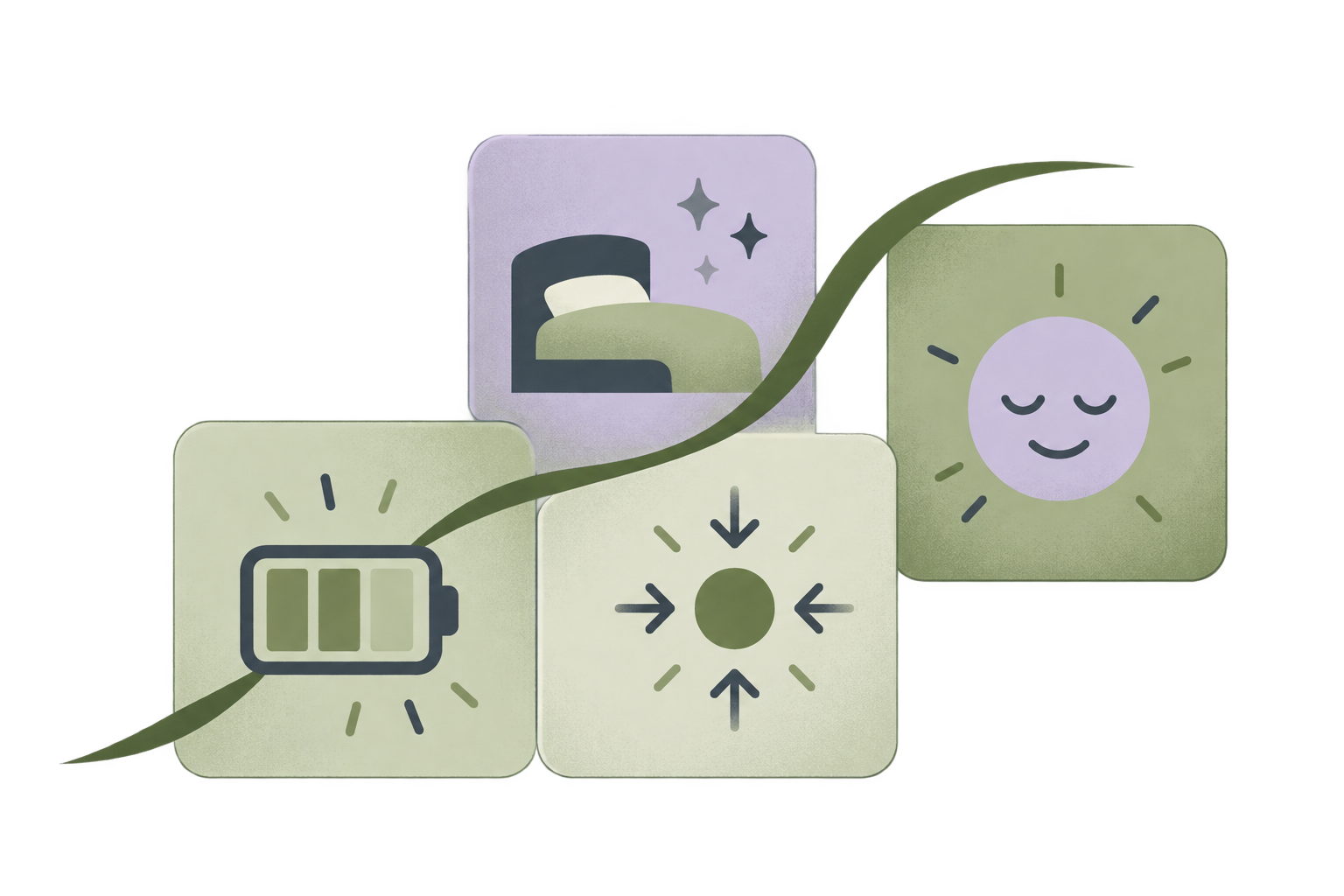
Four questions make a nervous system check in: how did you sleep, how much energy is there, where's the tension, what's the mood. It's a self-report that helps you size today's optional steps and build a record you can read back. It won't measure your vagus nerve, and I'd be suspicious of any phone app that claimed it could. What it does is stop you planning Tuesday as if it were last Saturday.
You wake after five hours, decide yesterday's training or sleep routine still stands, and by 11am you're on your third coffee and snapping at people who emailed politely. Your jaw stays tight, your shoulders creep up, and the plan still says to do everything. You search “tired but wired” or “brain fog by 3pm”, then save another tip without deciding what you'd actually change. By evening, “can't switch off at night” feels more useful than the word you picked for your mood that morning. Or the reverse happens: you slept well, feel genuinely good, and spend the day on the easy version out of habit. You can remember the plan perfectly. Remembering how you felt across the last five mornings takes more effort.
Common Questions
Does a nervous system check in measure nervous-system function?
No. It records what you report about sleep, energy, tension and mood, rather than testing nervous-system function. Those answers help you decide how much of an optional routine fits today. The useful question is what your reported state makes sensible to do next, starting with this morning's plan.
How long until patterns show up?
Usually a few weeks of fairly regular entries gives you something useful to read back. One score tells you very little; 30 entries let you compare days. Missing days is fine. Start with five mornings, then look for one thing that surprised you when you read them back on Friday.
What if my scores are always low?
Keep checking in and take the record to a qualified professional. Persistent low mood or energy deserves proper support, and a few weeks of entries makes that conversation easier. Keep the entries honest rather than adjusting them towards what you think a good day should look like.
Can I share my check-ins?
You can share a read-only link to your last 30 days of check-in scores. Written reflections stay private. That gives the person reading it a view of your recent scores without including everything you've written about those days. You can use the record when discussing persistent low energy or mood.
What goes into a nervous system check in
Four things, scored in your own words:
- Sleep: how long and how restoring, by your own judgement.
- Energy: how much you've got right now.
- Tension: where you're holding it. Jaw, shoulders, stomach, the back of the neck.
- Mood: the word that fits, even if the word is “meh”.
Answers can disagree with each other. Cheerful and exhausted is a real combination; so is calm and wired. Don't tidy them up.
I've come round to the view that the value sits in the asking more than in the number. The moment you have to score your tension, you notice your jaw. That act of noticing has a name, interoception: noticing signals from inside your body. It gives you something specific to describe before you decide what to do.
A cheerful mood doesn't require you to report good energy. Five hours of sleep doesn't tell you exactly where your tension sits. Keeping the four answers separate lets you describe the state you're actually in, including the combinations that look untidy on paper.
Cheerful and exhausted is a real combination.
Start with the easiest signal to locate. Write “jaw” beside tension this morning.
The nerdy bit: memory is a bad witness
Ask anyone on Friday how their week was and you'll get a story shaped by Thursday night and whatever happened most recently. Answers collected in the moment differ, sometimes a lot, from answers reconstructed later. I find that oddly comforting.
The method built on it has a mouthful of a name, ecological momentary assessment, which means asking people how they are while they're living it. A morning check-in uses that principle of recording close to the experience, rather than asking Friday's mood to describe Monday.
That's the case for a daily snapshot. Thirty entries start to show a shape: lower energy after late screens, tension that climbs every Sunday evening, better sleep on training days. Patterns raise good questions; they can't prove what caused what.
Your brain is constantly predicting what your body needs, and a record of your own states gives you something better than vibes to check those predictions against. Memory has preferences. The most irritating evening can get more attention than four ordinary mornings.
Read sleep and energy together, then look at tension and mood. If late screens seem relevant, keep that question specific when you review your next five mornings.