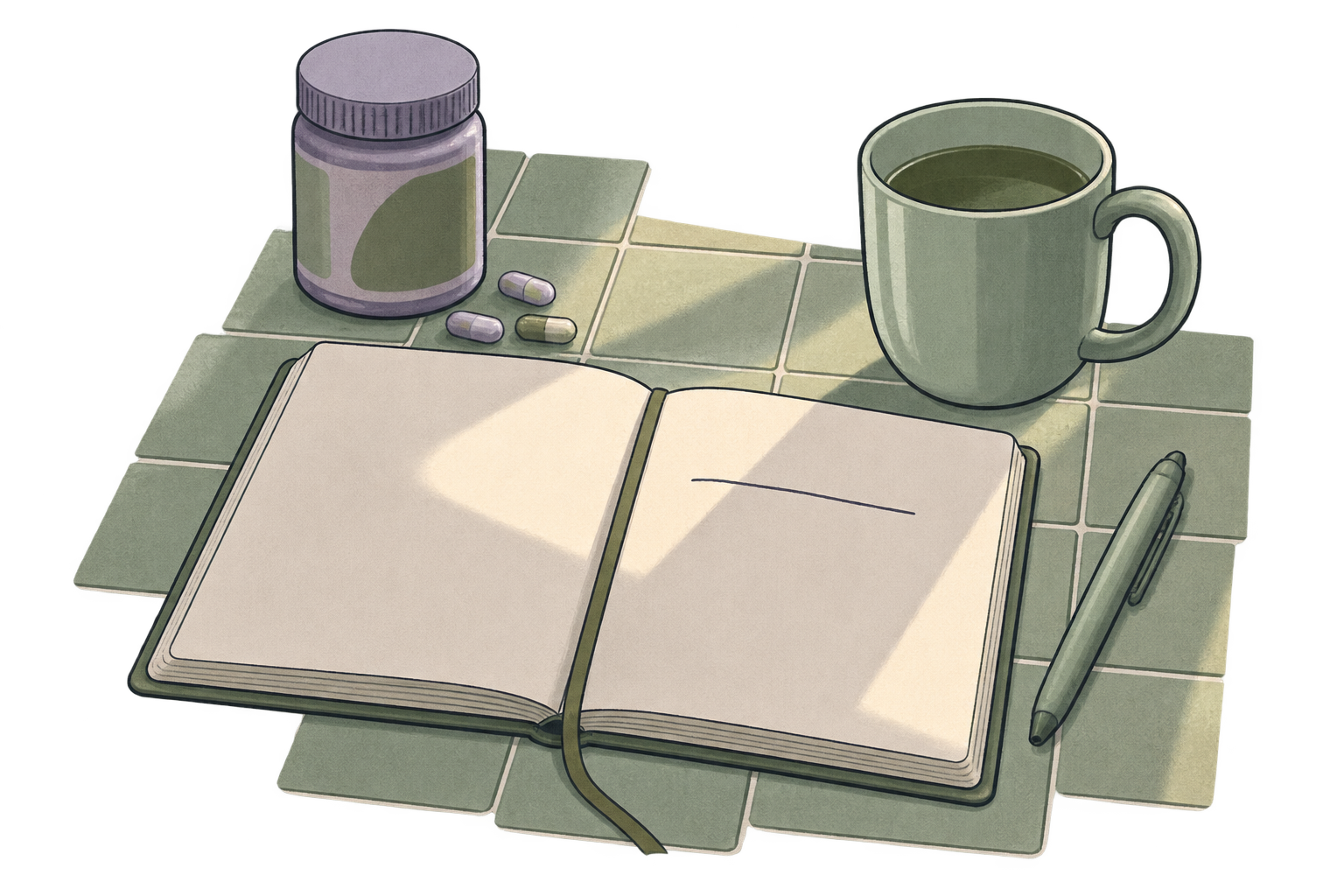
I used to think a wellness routine needed more consistency; now I think it needs a smaller version for days with less capacity. I’d keep one step tied to a clear goal and reduce the optional extras when sleep, energy or tension changes. I want a repeatable plan that makes room for an ordinary Tuesday. Even the relaxing bit has homework.
You get to 3pm with a jaw that won't unclench and a second coffee that doesn't seem to do anything. Your phone reminds you to meditate, your watch suggests movement, and the supplements beside the kettle still need sorting. You search “wellness routine feels overwhelming” while deciding whether 10 minutes of stretching counts if you spend it thinking about dinner. By evening, you're too tired to choose anything and too wired to settle. The routine has excellent attendance requirements. You look up “how to simplify my wellness routine,” then save another video with six things to add before bed. You wanted better sleep or steadier energy. Now you're checking whether you've been adequately relaxed today, with an unfinished journal open beside you at 11.47pm.
Common Questions
Why does my wellness routine feel like another obligation?
A routine can feel demanding when its time, effort and decisions exceed today's capacity. Each optional step adds something to remember, prepare or judge yourself against. A plan copied from several videos can also contain several competing goals. Pick one goal, such as a more consistent bedtime, before adding another step.
How do I simplify my routine without abandoning it?
Keep one repeatable action linked to your goal, then give it a smaller version for demanding days. For sleep, that could mean putting your phone away at 10pm rather than completing an elaborate evening sequence. Optional steps can wait. Your bedtime doesn't need a supporting cast of twelve products.
Can reflection help when tracking feels like more work?
Reflection can help if it leads to a decision. Interoception means noticing signals from inside your body, such as tension, hunger or sleepiness. Write one sentence about your state and one about what you'll change today. Stop there. A journal can survive an entry without a personal breakthrough.
What would I track instead of a perfect streak?
Track sleep, energy, tension and mood alongside the one action you've chosen. In the Protocols app, it's nervous-system check-in first: self-reported experience, rather than a test of nervous-system function. Those snapshots help size optional steps to gentle, steady or full days and reveal patterns over weeks; patterns don't prove cause.
Give your wellness routine one job
Goal-directed behaviour means choosing an action because it serves an outcome you actually want. That sounds obvious until a sleep routine contains 12 steps, three purchases and no agreed bedtime. Instagram is very thorough about additions. Deletions rarely get a tutorial.
I want to know what a step is for before I care how consistently you do it. If your goal is an easier transition to sleep, 10 minutes of gentle movement might earn a place because you find it settling. A supplement saved from a video needs a clearer reason than proximity to the kettle.
Name the goal first. Then choose one repeatable action and a smaller version you can do when capacity is lower. A goal-based protocol gives those decisions somewhere to live. For tonight, write one sentence: “I'm doing this to help with ___.” If you can't finish it, leave that optional step out for seven days.
A reminder can become another demand
Cognitive load is the amount of information you're trying to hold and use at once. A routine adds load when every step requires a decision: which exercise, which supplement, how long, whether yesterday counted. Even a pleasant activity can feel demanding when it arrives with instructions and a notification.
I used to give detailed routines too much credit. I've become more interested in how many choices they require at 9pm. A relaxation reminder can have remarkably strict manners.
Your state matters here. Poor sleep, low energy and tension can make the same set of decisions feel harder than it did yesterday. The full version may still suit another day; keeping it available doesn't require doing it tonight.
The smaller version deserves a name.
Decide that version in advance. If your usual movement session is 30 minutes, choose a gentle option such as five minutes of comfortable movement. Put both in the same place, then turn off one optional reminder tonight.
The nerdier bit: sleep pressure has timing
Sleep pressure is the growing urge to sleep that builds during waking hours. Adenosine, a chemical involved in that process, helps signal sleepiness. Caffeine blocks adenosine receptors, the places where that signal acts. It can make you feel more alert while your need for sleep continues to grow.
Caffeine's half-life, the time it takes to clear roughly half a dose, is often around 4–6 hours in adults, with substantial individual variation. Using a five-hour half-life as an example, 100 mg at 3pm leaves roughly 50 mg at 8pm. Bedtime tea has a fairly demanding assignment after that.
Feeling tired but wired doesn't identify a single cause. Still, adding another evening practice while ignoring afternoon caffeine makes the experiment harder to interpret.
I would record the time and approximate amount of your last caffeine alongside bedtime for seven days. Keep the rest reasonably steady. A sleep protocol becomes more useful when it includes what happened at 3pm, rather than only what you tried at 11pm.
Track the version, not just the tick
Self-monitoring means recording an action and its context so you can review what actually happened. A completed box tells you that you did something. It leaves out whether you slept five hours, felt tense all afternoon or chose the gentle version deliberately.
I care about that distinction because “missed the full routine” and “followed the smaller plan” lead to different decisions tomorrow. Streak culture has little interest in the distinction. Both days threaten the graphic.
Without tracking in the Protocols app, it's hard to hold several weeks of changing sleep, energy, tension and routine choices in memory. Recording them together makes it easier to compare similar days; patterns don't prove cause.
Use the nervous-system check-in first: self-reported sleep, energy, tension and mood, rather than a test of nervous-system function. Then size optional steps as gentle, steady or full. For seven days, record the version you chose and whether you did it. Leave the question of which version helps most open until you've got something to review.
What to do this week
Choose one outcome for the next seven days. Write “settle more easily before bed” or “have enough energy for an afternoon walk.” Keep it specific enough to notice in daily life. Leave the saved videos alone for now. They've supplied enough suggestions.
Give one action three sizes. For comfortable movement, try gentle at 2 minutes, steady at 10 minutes and full at 20 minutes, if those amounts suit you. Choose before the evening arrives. Full is an option for available capacity; it doesn't need to become tomorrow's expectation.
Remove one optional demand. Silence a reminder, put away an unused journal or pause an extra relaxation exercise for the week. Keep prescribed treatment unchanged unless your prescriber advises otherwise. I want fewer decisions at 9pm. Even leisure has acquired attendance rules.
Record only what helps the decision. Note your chosen day size, whether you did the action, your last caffeine time and how settling to sleep felt. Review after seven days. Look for what was manageable alongside your actual life, including the evening when dinner happened late. Leave one question open: does the smaller version help enough to keep?
Where this fits in your check-in
In the Protocols app, nervous-system check-in first means recording self-reported sleep, energy, tension and mood, rather than testing nervous-system function. Use that state to size optional steps as gentle, steady or full within a repeatable plan, then compare daily snapshots over weeks; patterns don't prove cause. I’d keep the sleep goal and caffeine timing beside those snapshots so memory doesn't have to reconstruct every afternoon. The free check-in includes the check-in only; protocols, stack checks, reminders and uploads require Member or Plus, both with a 7-day free trial.
Closing
Tonight, choose tomorrow's smallest useful action and turn off one optional reminder. I’d rather see a plan you can willingly repeat than another evening spent negotiating with a notification. Start with 2 minutes.
A wellness routine becomes easier to use when it has one clear goal and optional steps sized to today's capacity. Decide on gentle, steady and full versions before you're tired. Reduce repeated choices, notice afternoon caffeine when sleep is the goal, and track a few useful details over weeks. A daily check-in helps you choose an appropriate version today and notice what you actually repeat. Keep the next experiment small: one action, one fewer reminder, seven days.
Sources
John Sweller, Cognitive Load During Problem Solving: Effects on Learning, 1988.
Peter M. Gollwitzer, Implementation Intentions: Strong Effects of Simple Plans, 1999.
Ian Clark and Hans Peter Landolt, Coffee, Caffeine, and Sleep: A Systematic Review of Epidemiological Studies and Randomized Controlled Trials, 2017.
Protocols supports everyday wellbeing; it doesn't diagnose or replace your clinician.