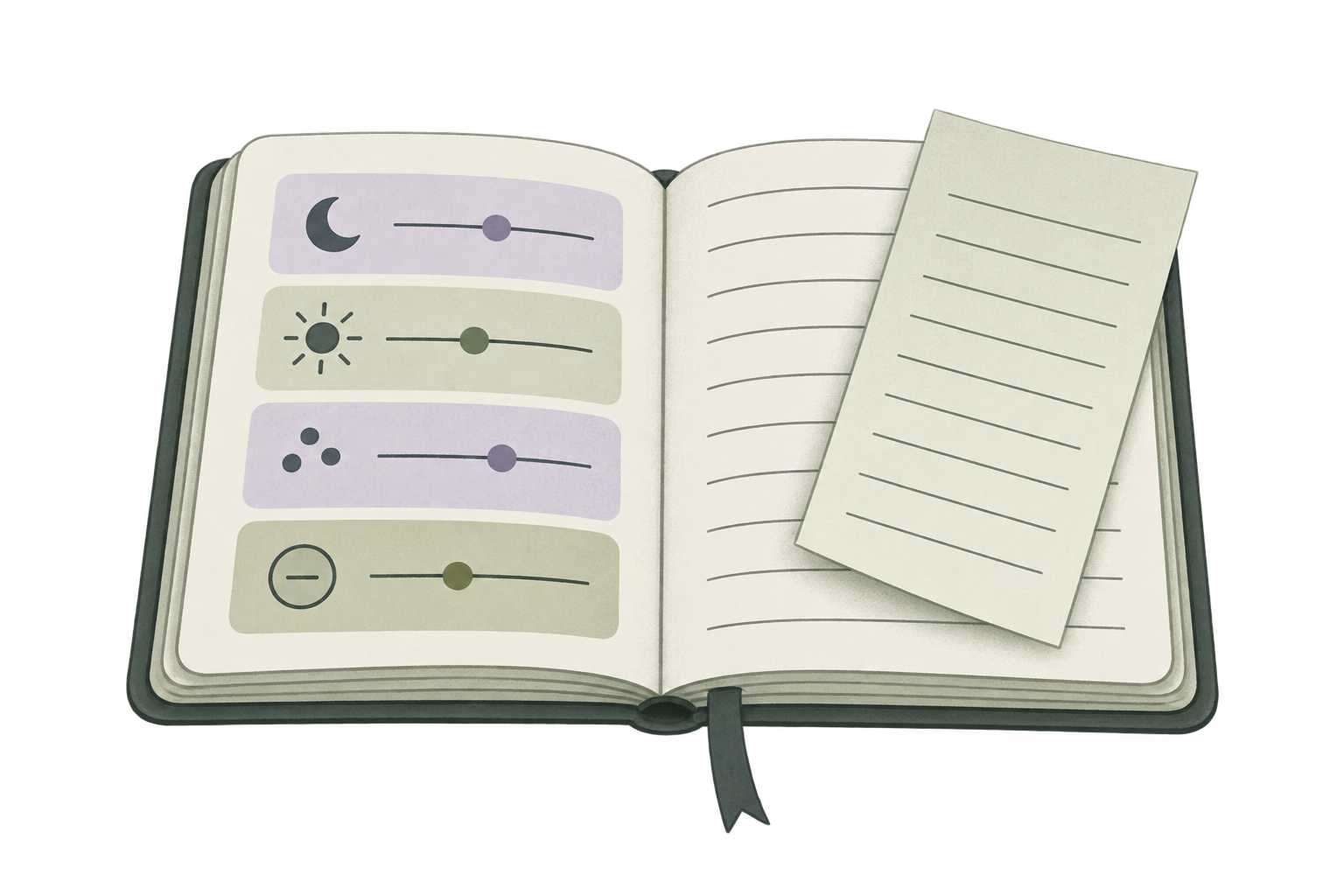
I've come to think journal prompts work better when they start with the state you're in, rather than the person you're meant to become. Somewhere in most homes there's a beautiful journal with six pages filled in. I think the prompts are usually to blame. “What are you grateful for?” at 6.30am, with a long to-do list and a jaw already clenched, produces the same three answers every day until you stop.
You open the page and feel vaguely examined. “How do you feel?” is too big a question for 7am, so you write “fine”, which is what you'd tell a neighbour. Your jaw's tight, your shoulders haven't relaxed, and you're already thinking about everything that needs doing before lunch. You search for “journal prompts for beginners”, then “what to write in a journal”, hoping for a question you can actually answer. Some evenings you're anxious for no obvious reason and can't sleep even though you're exhausted. “Journaling for anxiety” sounds useful until the prompt asks for three wins. The pen goes back in the drawer. You've got a page asking for reflection and barely enough capacity to decide when to go to bed.
Common Questions
What are good journal prompts for beginners?
Start with body-first questions: where tension sits, how you slept, and what would make the next hour easier. Pick one question and answer in a word or a line. A specific prompt gives you something you can notice now, without having to explain your whole day.
How long should a journal entry be?
As long as it needs to be accurate. On most days a word or a line is plenty. Keep weekday entries short, then write more on Sunday if you feel like it. Using the same few words for tension and mood makes entries easier to compare on day seven.
Are journal prompts good for anxiety?
Naming a feeling plainly may help some people feel less overwhelmed by it. Body-first prompts give you something specific to describe, such as a tense jaw or raised shoulders. If writing makes you spiral, stop after one line, and get proper support if anxiety is persistent.
Journal prompts that start in the body
If you already follow a sleep routine, start with what last night's sleep left you with. That gives the writing a goal: notice your state and choose something useful for today. A protocol is a repeatable plan built for a goal; the reflection helps you judge how much capacity you've got for its optional steps.
Pick one a day. Answer in a word, a line, or skip it.
- Where in my body do I notice tension right now?
- What did last night's sleep leave me with?
- What's the smallest thing that would make the next hour easier?
- What drained me yesterday that I still notice today?
- What felt steady, even briefly?
- What am I bracing for?
- If today is a gentle day, what's the one thing I'll still do?
- What did I notice about my jaw, shoulders or stomach before lunch?
I like the last one most because it's slightly absurd. Nobody has ever asked you about your jaw before lunch, and the answer is usually “clenched, since 9.15”. It's specific enough to answer without composing a statement about your life.
One word is a valid entry. A sentence is generous.
The question needs to fit the capacity you have that day. A gratitude prompt can wait while you notice that your shoulders have been raised all morning. The page will survive the omission. Pick the question you can answer before lunch.
The nerdy bit: why naming a feeling helps
Affect labelling means putting a feeling into words. In brain-imaging experiments, labelling an emotion has been associated with reduced activity in the amygdala, a brain region involved in processing threat and emotion, and greater activity in parts of the prefrontal cortex involved in regulating emotion. That finding doesn't guarantee that a journal entry will make you feel calmer.
Keep the words plain. “Tense”, “irritated” and “flat” give you something specific to describe. “Irritated by the noise” gives the entry more detail than a paragraph about the direction of your life. The direction of your life can have Sunday.
Interoception, noticing signals from inside your body, is the other half. Prompts that point you at a body part practise that noticing. I've come to think it's the main skill journaling builds, more than insight or gratitude. You notice your jaw, then find a word for what you feel, rather than beginning with an explanation you haven't got yet.
Writing your experiences as a story over several days has its own evidence behind it. For this exercise, start smaller: one body signal and one accurate word. At 7am, “shoulders tense” is an entry you can finish.