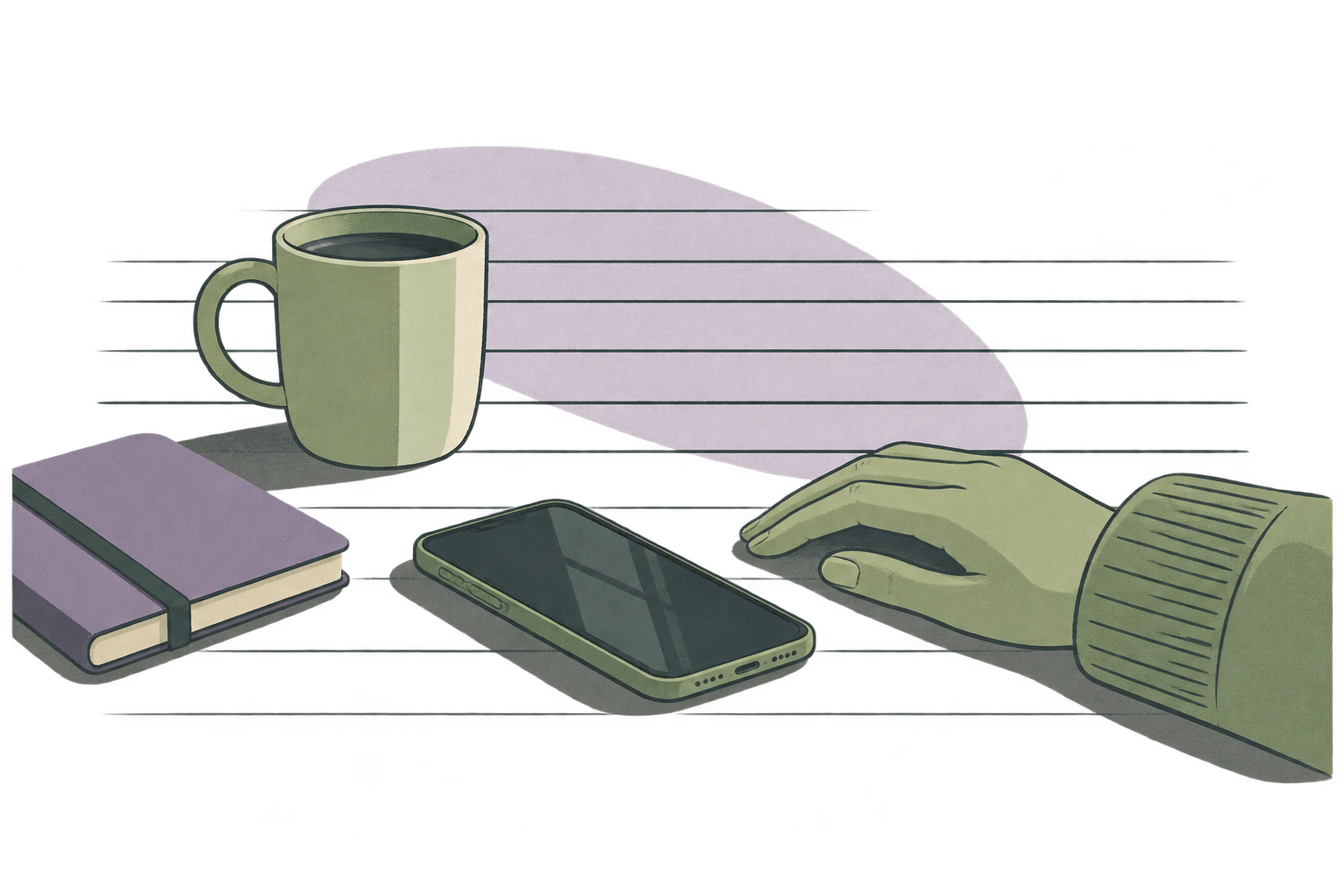
I used to think learning how to calm your nervous system meant finding a morning routine I'd follow every day. I now start with the state I'm actually in, then choose a small action: comfortable slower breathing, less stimulation or gentle movement. I want a routine that takes last night's sleep into account before adding another demand. The alarm has no opinion.
You wake at 6.30am and reach for your phone before you've noticed your jaw. Breakfast happens standing up, your shoulders stay raised, and the workout you saved last night already feels ambitious. You search “why do I wake up anxious” while the coffee brews, then “breathing exercises for stress” between messages. Your morning routine has acquired quite a lot of homework. By 3pm, the second coffee doesn't land; you're tired, restless and oddly annoyed by ordinary questions. Later, “tired but wired at night” joins the search history. You'd like a clearer baseline: enough attention to notice your state, enough flexibility to match the plan to your capacity. Instead, you get another video recommending an ice bath before you've managed breakfast.
Common Questions
What's a practical first step to calm your nervous system?
Put your phone aside and try 1 minute of comfortable, slightly slower breathing, without forcing deep breaths or holding your breath. Autonomic regulation is your body's automatic adjustment of functions such as heart rate and digestion. Gentle breathing may help you settle; stop if you feel dizzy or uncomfortable.
How do you know what you need this morning?
Interoception means noticing signals from inside your body, such as tension, hunger or a racing heart. I start by noticing sleep, energy, tension and mood before choosing an optional step. Your saved workout has limited information about last night. Check your jaw and shoulders before deciding how hard to train.
Should you use the same calming routine every day?
Keep a familiar starting point and adjust the effort to your capacity. After a rough night, 5 minutes of easy walking may fit better than a demanding workout. I prefer a repeatable plan with room for ordinary variation. Choose one manageable action, then notice how you feel afterward.
How can a check-in help you choose what to do?
In the Protocols app, it's nervous-system check-in first: self-reported sleep, energy, tension and mood, rather than a test of nervous-system function. Daily snapshots help size optional steps as gentle, steady or full and show patterns over time; patterns don't prove cause. See how it works before choosing today's optional steps.
Start with state: how to calm your nervous system
Interoception means noticing signals from inside your body: a tight jaw, a fluttering stomach, the effort it takes to sit still. Those signals give you something concrete to respond to before a saved routine starts making decisions. They also need context. Hunger, poor sleep and an approaching deadline can feel inconveniently similar at 7am.
I pay more attention to a cluster of signals than to one tense shoulder. Before opening messages, notice your breathing, muscle tension and energy for 30 seconds. Keep your eyes open if that feels easier. You’re gathering enough information to choose an action, rather than inspecting every sensation until breakfast goes cold.
Keep it ordinary.
If you’re restless and tense, try less input. If you’re sluggish, try daylight and easy movement. A useful intention names what you want that action to support: eating breakfast sitting down, for instance. Calm can be modest enough to include a chair.
Slower breathing, with slightly less theatre
The autonomic nervous system regulates automatic functions including heart rate and digestion. Its sympathetic branch helps mobilise you; its parasympathetic branch supports functions such as recovery and digestion. Both remain active in changing proportions. You need mobilisation to get through a morning, including the entirely legitimate task of finding your keys.
Here’s the nerdier part. Respiratory sinus arrhythmia is the normal change in heart rate across a breath: it generally rises during inhalation and falls during exhalation. Slower breathing can strengthen this rhythm and its interaction with blood-pressure regulation. That helps explain why comfortable paced breathing can reduce arousal for some people.
I’ve stopped treating a longer exhale as a universal instruction. Comfort matters more than winning the breathing exercise.
Try 2 minutes of gentle breathing, perhaps 4 seconds in and 6 seconds out, which gives 6 breaths per minute. Keep the breaths small and unforced; return to normal breathing if you feel dizzy or short of breath.
The breathing exercise can stay easy.
Then notice whether your jaw feels any easier to release.
Give the morning less to react to
Attention repeatedly shifts towards things that seem urgent or important. Messages, headlines and videos supply plenty of candidates before you’ve decided what matters today. Each item can prompt another thought, another decision or another physical response. The phone has excellent availability and no interest in your breakfast.
I prefer removing one source of stimulation before adding another regulation technique. A morning already crowded with instructions rarely needs a more elaborate set of instructions.
Try leaving your phone out of reach for the first 10 minutes after getting up. Open the curtains, eat if you’re hungry, or walk gently around the room. Choose one action that fits your capacity. You can find more options in the nervous-system regulation guide, but today only needs one.
Persistent or worsening anxiety, sleep disruption or physical symptoms deserve professional assessment. For this morning’s experiment, make the change specific: messages wait until after breakfast.
Track the day the routine actually meets
Sleep pressure is the drive to sleep that builds while you’re awake. Short sleep can leave that drive high while stress keeps you alert, producing the familiar tired but wired state. Adding a demanding workout to that combination increases today’s load, even if the workout looked sensible when you saved it.
I’d track last night’s sleep, morning energy and tension, the action chosen, and how manageable the afternoon felt. Keep the action similar for 7 days so there’s something recognisable to compare. Memory tends to remember the spectacularly bad Tuesday.
Holding sleep, state and several routines together across weeks gets awkward without tracking them in the Protocols app. Its daily snapshots put those reports alongside the day-sized plan; patterns can suggest a useful experiment, though they don’t prove cause.
Use nervous-system check-in first: self-reported sleep, energy, tension and mood, rather than a test of nervous-system function. Through how it works, choose gentle, steady or full for optional steps. Leave the question of whether breathing or fewer messages helped open until you’ve recorded Friday afternoon.
What to do this week
Choose one ordinary goal tonight. Write down what a calmer morning would let you do: eat breakfast sitting down, leave without rushing, or begin training with enough energy. “Regulate everything” gives you very little to act on at 7am. I prefer a goal you can recognise while it’s happening.
Notice your starting state before messages. Record sleep, energy, tension and mood using the same simple scale each morning. Add one relevant detail, such as waking at 3am or having coffee before food. Keep it brief. Your breakfast already has enough competition.
Choose one optional action for today. Try 2 minutes of comfortable slower breathing if you’re tense, or 5 minutes of easy movement near daylight if you’re sluggish. If attention to breathing increases discomfort, choose the movement instead. Leave the phone out of reach until you’ve finished, then notice whether the action helped you do your chosen task.
Review after 7 days, then keep observing. Record what you actually did alongside your starting state and a short note at 3pm. I’d look for an action that feels manageable across several mornings before adding another. Seven days gives you an initial comparison; a few more weeks includes more variation in sleep and daily load. The most impressive routine can remain in your saved videos.
Where this fits in your check-in
In the Protocols app, it’s nervous-system check-in first: self-reported sleep, energy, tension and mood, rather than a test of nervous-system function. Use that snapshot to size optional steps as gentle, steady or full; low capacity might mean one small action, while greater capacity leaves room for your usual routine. The check-in guide explains the process, and nervous-system regulation gives context for choosing an action. Tracking your state alongside completed steps helps you compare days over time, though patterns don’t prove cause.
Closing
Tonight, choose tomorrow’s goal and put your phone somewhere you’ll have to stand up to reach it. Leave the question of which action suits you best open until you’ve tried it on a few ordinary mornings.
Learning how to calm your nervous system starts with noticing your current state and choosing an action that fits your capacity. Comfortable slower breathing, gentle movement or less phone input can give you a manageable place to begin. Pick a concrete goal, record sleep, energy, tension and mood, and track what you actually do. Compare mornings over several weeks. Keep optional steps smaller on difficult days, and judge the routine by whether it helps with the morning you’re having.
Sources
A. D. Craig, How do you feel? Interoception: the sense of the physiological condition of the body, 2002.
Marc A. Russo, Danielle M. Santarelli and Dean O’Rourke, The physiological effects of slow breathing in the healthy human, 2017.
Andrea Zaccaro et al., How Breath-Control Can Change Your Life: A Systematic Review on Psycho-Physiological Correlates of Slow Breathing, 2018.
Protocols supports everyday wellbeing; it doesn't diagnose or replace your clinician.