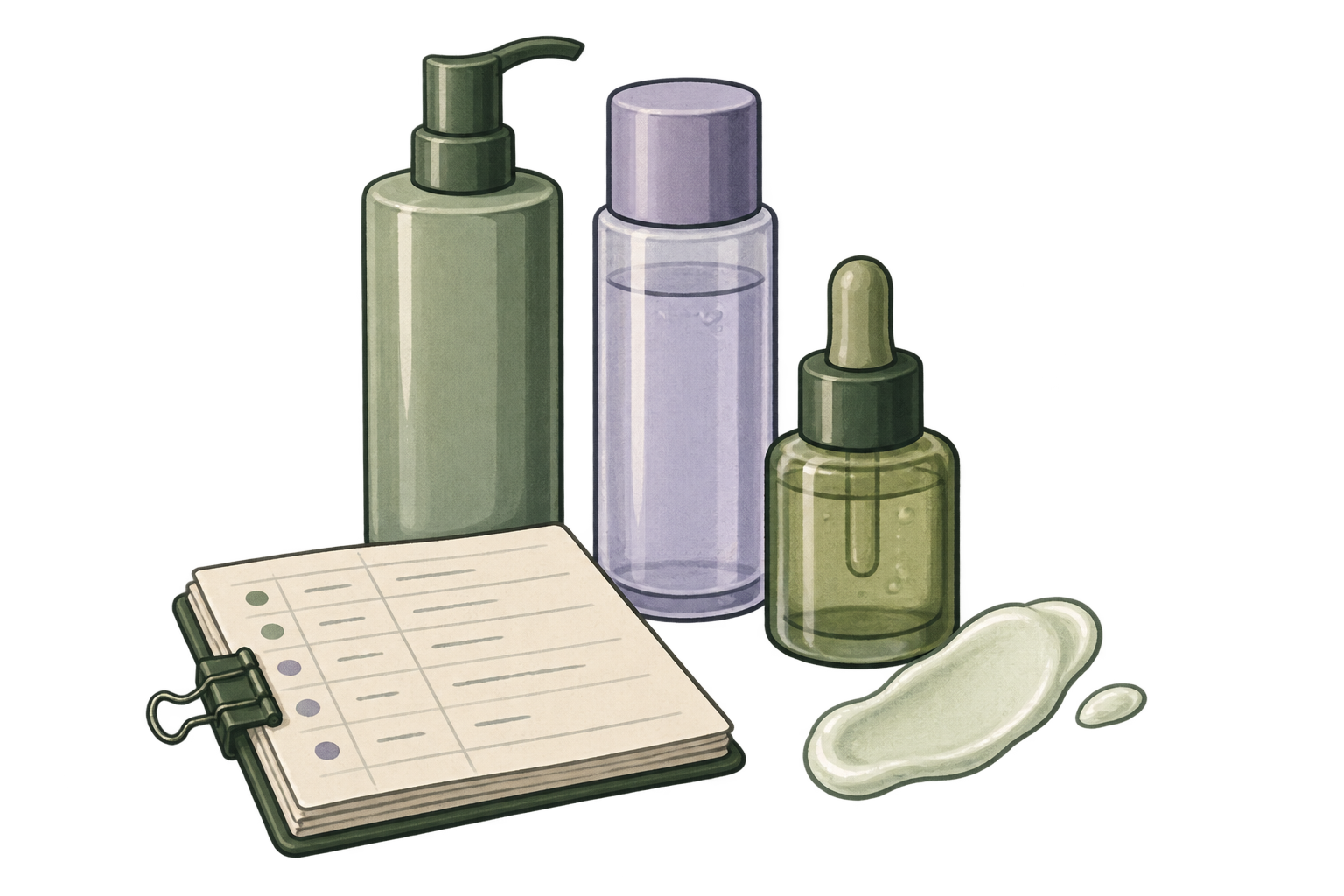
I used to think a skincare routine tracker needed a record of every product; I'd now start with one goal, what you applied and how your skin felt afterward. Your routine already qualifies as a protocol: a repeatable plan built for a goal, such as reducing dryness. I care more about whether your cheeks still sting at 3pm than whether you completed seven steps. The bottle count is easy to improve.
You wash your face at 11pm with your jaw still tight, then try to remember whether yesterday was the exfoliant night or the retinoid night. Your cheeks feel tight, your forehead looks shiny, and the moisturiser that felt fine last week suddenly stings. You search “why does my skincare sting” while holding a bottle whose instructions assume considerably more attention than you have left. Apparently, bedtime needed more instructions. By morning, you're comparing “skin purging vs irritation” photos and wondering whether to add something calming or stop something active. You want fewer rough patches, but your notes contain purchases rather than changes in your skin. You remember the expensive serum. You're less certain about the three evenings you used it, the short sleep, or when the tightness started.
Common Questions
What is worth logging in a skincare routine tracker?
Track one goal, the products you actually applied and one or two relevant observations, such as tightness or stinging. Record product changes with a date. I favour a small log you can compare over several weeks; a complete inventory still leaves the question of what helped your skin unanswered.
Why track how skin feels alongside what you apply?
The skin barrier is the outer layer that limits water loss and helps keep irritants out. When it's disrupted, products may sting and skin may feel dry or tight. Record discomfort on a consistent 0–3 scale, alongside what you applied, so you can compare changes with your usual baseline.
Should you change your routine when you're tired?
Low capacity can make a complicated evening routine harder to follow. Decide beforehand which optional steps you can leave out on a gentle day, while keeping prescribed treatment as directed. The skin protocol gives this a goal-led structure. Seven steps remain seven steps at 11pm. Choose the essentials before then.
Can tracking reveal which product caused a reaction?
Tracking can show that stinging began after a product change, but patterns don't prove cause. Change one optional product at a time and note the date, rather than replacing three together. Stop a product that causes irritation; persistent or severe symptoms deserve medical advice. Keep the product name available.
A skincare routine tracker needs an outcome
A useful record starts with one change you want to notice: less tightness after washing, fewer flaky patches, or better tolerance of a prescribed routine. Those goals need different observations. Ten products entered neatly still tell you very little about whether washing your face feels unpleasant.
I’d choose one main symptom and give it a simple 0–3 score: absent, mild, moderate or severe. That’s a personal comparison scale, not a validated skin assessment. Record it at roughly the same time, perhaps 10 minutes after cleansing, before adding optional products. Don’t delay moisturising just to produce a better observation.
Consistency helps here. A score taken after a hot shower and another taken before washing describe different conditions. Your cleanser hasn’t necessarily developed a personality overnight.
Start with a skin protocol aimed at your chosen goal, then record what you actually applied, including the product name and strength when listed. Keep the first week’s question narrow: does tightness follow the same washing step?
The nerdier bit: water loss and irritation
The stratum corneum is the outermost skin layer: flattened cells surrounded by fats that help limit water loss and exposure to irritants. Transepidermal water loss means water passing through the skin and evaporating. Instruments measure it in grams per square metre per hour; a tight cheek can’t supply that measurement.
Skin sensations still matter. Stinging, redness and flaking can help you notice poor tolerance, but they don’t identify the cause. A product’s strength, formulation, frequency and combinations all affect exposure. Two exfoliant nights followed by a retinoid night deserve a more useful description than “mostly consistent.”
I’ve stopped treating a longer ingredient list as a better explanation. Knowing that an acid was used on 3 evenings tells me something different from knowing its name.
Track the exposure, then the response.
For the next 7 days, record active-product nights alongside stinging and flaking. Avoid adding another optional active while you’re trying to understand the pattern. Persistent or worsening irritation deserves a clinician’s assessment; keep prescribed treatment changes with your prescriber.
Count applications, without rewarding endurance
Repeated exposure can cause cumulative irritation: skin becomes sore after several applications even when the first felt fine. That makes frequency worth recording, especially when products with overlapping effects arrive from different recommendations. The videos rarely compare calendars.
I’d record an application, a skipped application and the reason for skipping separately. If you planned 3 optional active nights and completed 2, the useful detail is whether the third was forgotten or left out because your skin stung. An adherence percentage alone loses that distinction. A streak can look excellent while your cheeks feel dreadful.
Memory struggles with product nights, symptom changes and everything else happening that week. In the Protocols app, daily check-ins alongside tracked routine steps make those details easier to compare over time; patterns don’t prove cause.
Keep it boring. Tonight, enter what touched your skin rather than what the routine said should happen, then add one short observation: “stung on application” is enough.
Let today’s capacity change the optional steps
Stress can affect skin through immune signalling and skin-barrier processes, while poor sleep can also change how much attention you have for a routine. A tense day provides context, not an explanation for every red patch. The jaw that won’t unclench at 3pm and the tired but wired evening are worth recording without blaming either for your moisturiser.
I want a baseline that survives an ordinary low-capacity night. That might mean gentle cleansing when needed and moisturiser, with broad-spectrum SPF 30 or higher during the day. Optional cosmetic steps can wait when you can barely keep your eyes open. Your exfoliant has no attendance requirement.
The approach is nervous-system check-in first: self-reported sleep, energy, tension and mood, rather than a test of nervous-system function. Use that state to choose gentle, steady or full optional steps, as described in how it works. Tonight, decide your gentle version before you reach the bathroom; whether the stinging follows one product or several exposures remains a question for the record.
What to do this week
Choose one outcome for 7 days. Pick tightness, stinging or flaking, and use the same 0–3 score at a similar point in your routine. Keep the question small enough to answer at 11pm. “Better skin” leaves rather a lot open to interpretation.
Record applications, including omissions. Note the product, strength if listed, and whether you applied it. Add a short reason when you skip an optional step: forgotten, too tired, or skin uncomfortable. I’d rather see that distinction than a perfect completion rate. Leave the blank honest.
Keep optional additions out of the experiment. Use the week to observe your existing routine rather than introduce another acid or serum. Keep basic care, including moisturiser and daytime sun protection, consistent. A new purchase creates another question before you’ve answered the first.
Review once, after 7 days. Compare active-product nights with symptom scores and your recorded sleep, energy and tension. I’d look for repeated sequences before deciding what deserves attention. Seven days gives you an initial record; visible changes in acne or pigmentation can take longer. Memory tends to remember the expensive bottle.
Where this fits in your check-in
In the Protocols app, it’s nervous-system check-in first: self-reported sleep, energy, tension and mood help describe today’s state and capacity, rather than test nervous-system function. A gentle, steady or full day can help size optional skincare steps; a full day doesn’t call for extra actives, and skin tolerance still matters. Use your daily check-in alongside a goal-led skin protocol to compare today with your baseline over time; patterns don’t prove cause. I’d record a low-capacity evening separately from an evening when moisturiser stung, so the next review preserves both details.
Closing
Tonight, choose one symptom and record what you actually apply. Leave the question of which product caused last Thursday’s stinging unresolved until there’s enough detail to examine. Protocols require Member or Plus, both with a 7-day free trial; the free start includes the check-in only.
A skincare routine tracker earns its place by connecting one goal with actual applications and how your skin feels afterward. Record product frequency, a simple symptom score and why you skipped optional steps. Your daily state helps you choose a manageable routine, while skin tolerance guides what deserves attention. Review the record over weeks rather than rewarding consecutive nights of use. Keep the first week simple: one outcome, consistent observations and no new optional active competing for an explanation.
Sources
Peter M. Elias, Stratum corneum defensive functions: an integrated view, 2005.
Enzo Berardesca, EEMCO guidance for the assessment of stratum corneum hydration: electrical methods, 1997.
D. K. Belsito, The diagnostic evaluation, treatment, and prevention of allergic contact dermatitis in the new millennium, 2000.
Protocols supports everyday wellbeing; it doesn't diagnose or replace your clinician.