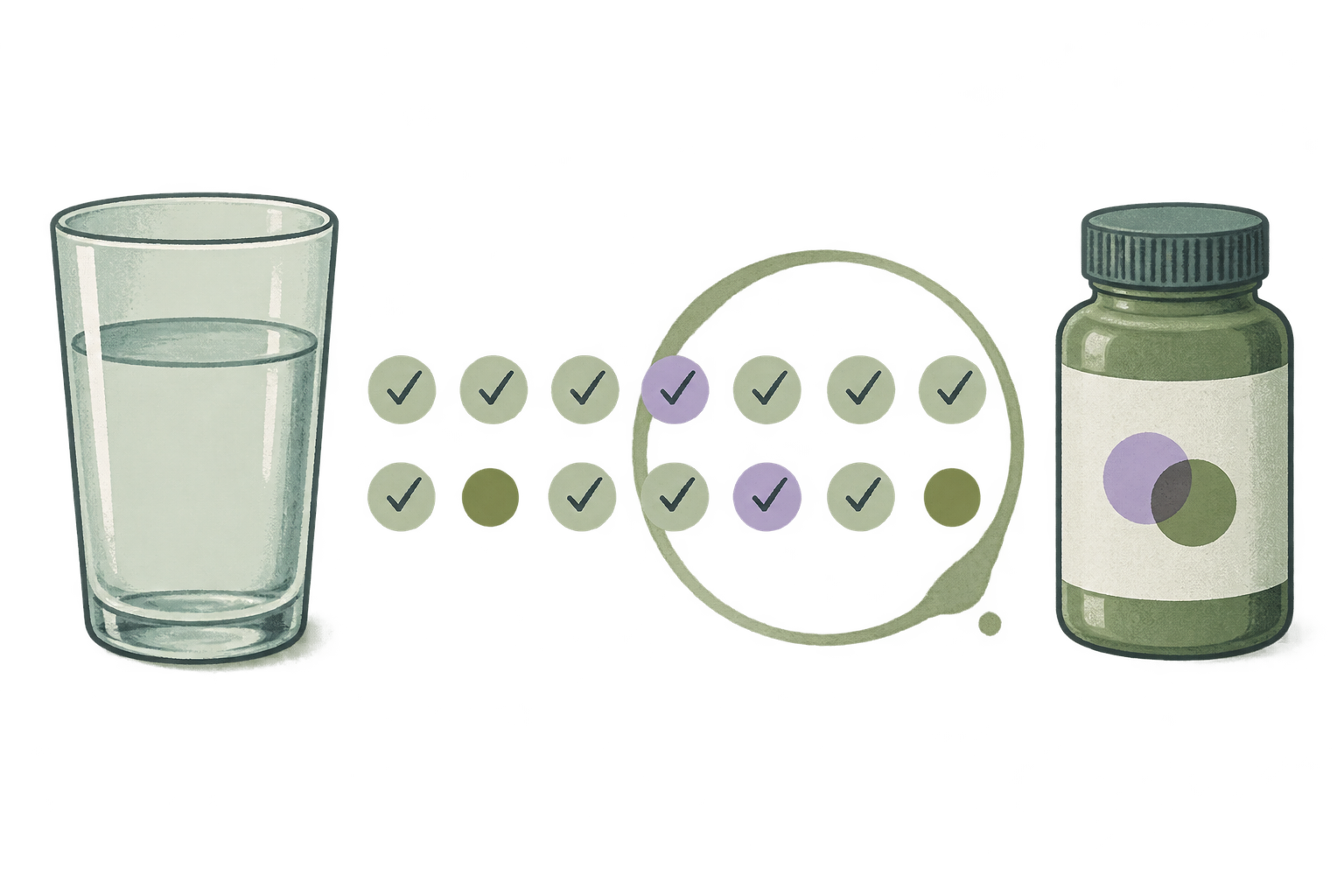
I used to judge a longevity routine by how much it included; now I want to see what happens to sleep, energy and training recovery before adding anything. I’d keep optional additions on hold for 14 days and track a few signals against one clear goal. I’ve stopped treating a longer supplement list as evidence of better thinking. The supplement aisle has other preferences.
You take the morning capsules, fit in a workout and try to finish dinner early enough for the fasting window you saved on Instagram. By 3pm, your jaw won't unclench and the second coffee doesn't land. You search “best longevity supplements” while waiting for the kettle, then “tired but wired at night” when you're still awake at 11.47pm. Your routine looks organised in the notes app. Your evenings have declined to cooperate. You can remember buying magnesium, but you're less sure whether the restless nights started before the harder training block or after it. Another video offers a “longevity protocol for beginners,” with six more things to do. You'd like enough energy to cook dinner without negotiating with yourself. The video has moved on to cold plunges.
Common Questions
What should you track before adding to a longevity routine?
Start with one goal, such as more consistent sleep, and record bedtime, waking time, daytime energy and training load for 14 days. Include supplements and their doses so changes have context. Treat this as a practical observation window: longevity itself can't be assessed through two weeks of better mornings.
Why can a healthy-looking routine leave you tired but wired?
Arousal is your body's level of alertness, and it can stay high even when you feel exhausted. Late caffeine, hard evening training and stress can contribute. Interoception means noticing signals from inside your body, including a clenched jaw or tense stomach. Record when those signals appear alongside what you did that day.
How long should you watch a pattern before changing something?
Use 14 days as a manageable starting window, then look for repeated timing rather than one unusually good Tuesday. Patterns don't prove cause, and some effects take longer to notice. Change one optional habit at a time if you choose to experiment; keep medication decisions with your prescriber.
How does a check-in help you choose today's routine?
In the Protocols app, the order is nervous-system check-in first: self-reported sleep, energy, tension and mood, rather than a test of nervous-system function. Those daily snapshots help size optional steps to gentle, steady or full capacity and show patterns over time. A poor night might mean choosing a gentle walk today.
Give your longevity routine a job
A useful goal makes the next decision smaller. “Live longer” gives you very little help when deciding whether to take another capsule at breakfast. “Finish my usual training session and have enough energy to cook dinner” gives you something you can actually observe over 14 days.
The mechanism here is feedback: noticing what happens after an action, then adjusting that action. A repeatable plan needs an outcome you can recognise. Otherwise, taking everything becomes the goal, and the original reason quietly disappears.
I want a routine to earn its place through something more useful than the satisfaction of completing it. A swallowed capsule is very easy to count. Dinner takes more effort.
Pick one near-term goal and two signals: afternoon energy and next-day soreness, for example. Write down what “better” would look like in ordinary life, such as cooking at 7pm without needing to lie down first. These signals can guide daily choices; they can't establish that an intervention extends life.
Give the routine a goal before giving it another step.
The nerdier part: sleep pressure meets caffeine
Sleep pressure is the growing urge to sleep during time awake. Adenosine, a chemical involved in that process, helps signal sleepiness. Caffeine blocks adenosine receptors, the places where that signal acts, so you can feel more alert while your need for sleep continues to grow.
Timing matters. Caffeine's half-life, the time needed to clear half a dose, is often around 4–6 hours in adults, with substantial variation. Using a 5-hour half-life as an illustration, 100 mg at 3pm leaves roughly 50 mg at 8pm and 25 mg at 1am. Your bedtime has no authority over that calculation.
I used to give the coffee count more attention than the coffee time. I've changed my mind. Two coffees before breakfast and two spread into late afternoon deserve separate entries when you're trying to understand a tired but wired evening.
For 7 days, record caffeine timing and approximate dose alongside bedtime and morning energy. If sleep is your chosen goal, use a sleep protocol to make one timing change repeatable while keeping the other optional additions steady.
Count the demand your routine creates
Training adaptation happens through a cycle of stress and recovery: exercise creates a demand, and recovery allows changes that improve capacity. More demanding sessions also need more recovery. Enthusiasm doesn't shorten that process.
A routine can combine hard training, a longer fasting window and less sleep without ever asking whether those choices fit together. The recovery supplement remains remarkably willing to join in.
I pay attention to total load: the combined demands of training, daily responsibilities and restricted recovery time. The felt state matters here. Legs that still feel heavy during the warm-up, unusual irritability and declining performance are reasons to look at the whole week before adding intensity.
Record session duration and effort on a 0–10 scale, then note how the usual warm-up feels the next day. On a low-capacity day, make one optional adjustment, such as replacing intervals with 20 minutes of easy walking. Keep the goal; reduce today's demand.
Watch the sequence before adding more
Interoception means noticing signals from inside your body, including tension, hunger and fatigue. It gives you useful observations, but memory struggles with sequence: when the poor sleep started, which training day preceded it, and when the new supplement arrived.
I prefer a brief daily record to a detailed reconstruction on Sunday. Sunday tends to remember the worst night.
Holding sleep, energy, tension, mood and routine changes in memory makes comparisons difficult. In the Protocols app, nervous-system check-in first means recording those self-reported signals, then sizing optional steps to a gentle, steady or full day; the check-in doesn't test nervous-system function.
Use the check-in alongside a record of what you actually did for 14 days. Look for repeated sequences rather than one impressive morning, since patterns don't prove cause. Whether the newest capsule deserves a place can stay unanswered while you record tonight's bedtime.
What to do this week
Choose one outcome for the next 14 days. Make it something you can notice: enough energy to cook at 7pm, fewer tired but wired evenings, or less soreness before your next session. I’d choose the outcome that would make an ordinary Tuesday easier. Longevity can tolerate a specific question.
Record what you already do. Write down supplement ingredients and doses, caffeine timing, training duration and your usual eating window. Include the optional things you do occasionally. A capsule taken three days a week still belongs on the list. Keep medication decisions with your prescriber.
Keep the observation small. Each morning, record sleep, energy, tension and mood; add one goal-specific observation, such as whether you cooked dinner. Use the same simple scale each day. You’re looking for a baseline, your usual range under current conditions, before deciding what deserves attention. Memory tends to favour yesterday.
Let capacity change optional effort. After a short night with heavy legs, choose an easy 20-minute walk rather than an extra hard session. On a steadier day, follow the usual plan. I’d record the choice alongside the state that prompted it, so a shorter session remains visible as a deliberate decision.
Review before adding. At day 7, check which entries are missing; at day 14, look for repeated combinations of timing, load and symptoms. Patterns don’t prove cause. Choose one optional change to examine next, leaving the others steady. The unopened supplement can wait.
Where this fits in your check-in
In the Protocols app, it’s nervous-system check-in first: self-reported sleep, energy, tension and mood, rather than a test of nervous-system function. Those daily snapshots help you size optional steps as gentle, steady or full, keeping your chosen goal in view as capacity changes. The check-in and tracking approach keeps today’s state beside repeated actions over weeks, so you can review more than whichever night you remember best.
Closing
Tonight, write down your goal and the time of your last coffee. Tomorrow, record how you slept before choosing the optional effort. Whether any particular addition deserves a permanent place can remain unanswered for another fortnight.
A longevity routine becomes easier to judge when it has one observable goal and a record of what happens alongside it. Hold optional additions for 14 days, track sleep and daytime capacity, and note caffeine timing and training load. Use your daily state to choose gentle, steady or full optional effort. Review the repeated combinations before changing one thing. Better evenings and more manageable training are useful outcomes to watch while the larger question of lifespan stays open.
Sources
Institute of Medicine, Caffeine for the Sustainment of Mental Task Performance: Formulations for Military Operations, 2001.
Drake et al., Caffeine Effects on Sleep Taken 0, 3, or 6 Hours before Going to Bed, 2013.
Kellmann et al., Recovery and Performance in Sport: Consensus Statement, 2018.
Protocols supports everyday wellbeing; it doesn't diagnose or replace your clinician.